Situated Stories: What the map cuts up, the story cuts across.
The Plague
The city of Naples has a particularity: it has one face on the surface and another underground. Story tells, that since 2.500 b. C., neapolitanean soil it's going to fill up more and more with catacombs, aqueducts, crypts, quarries, passages and any kind of hidden spaces. The city will show a particular predisposition to underground burials, to the worship of the dead and souls in pain, at least until the 19th century. The Fontanelle Cemetery is just one of the most famous examples, whose origin can be traced in the XVI century, when the city endured three popular uprisings, three earthquakes, five eruptions of Mount Vesuvius, and three epidemics. It was not until the arrival of Napoleon and his laws, that the cemeteries were relocated outside the urban limits, to avoid the proliferation of infections. The Saint Gennaro Catacombs (Sanitá neighbourhood), three kilometres north of the city center, are the oldest in the city and they hold its religious history since the II century AD. From patron saints and martyred bishops, almost 2.000 years of life, death and memories are held within the volcanic yellow tuff of Naples. The catacombs served as both a burial place and a place of worship, but there is much more to them than stories of the past. I will come back to this later.
Just as in the bowels of the Sanità district the remains of past generations sleep, 50 kilometres to the north, there is a generation that lives, and among them are voices that borrow other voices to bring their stories to the surface. Fondazione Campania dei Festival was created in 2007 and regularly produces, promotes, and manages a complex system of projects. Among the projects launched in recent years is to be mentioned Quartieri di Vita, initiated in 2016 and celebrated every December. Quartieri di Vita seeks and supports organizations operating in at-risk areas of Campania through workshops that use Theatre as a tool for integration and professional training.
In 2022 Christian Costa and Antonio Nardelli met for the first time to work with a group of young people from the Castel Volturno area assembled by Antonio, who has always been dedicated to the education of the local youth. Some of them were part of the association Teenspark, founded in 2008 in Grazzanise, and have been participating in the theatre laboratories guided by Antonio, that ultimately led to the founding of Teatro Folli Idee in 2010. This association aimed to give the context a cultural identity, steering young people away from the streets and bringing them closer to theatre and other forms of artistic expression. Over the years the project has expanded to neighboring areas, like a sort of plague – I would say.
Once upon a time, in that area, there was a magical place: La Pineta di Castel Volturno (Castel Volturno pine forest). Just as the plague had devastated countless lives centuries ago, now it was the turn of this habitat rich in biodiversity: the pine trees had withered, affected by the pine tortoise scale, Toumeyella Parvicornis (a species native from North America), and instead of the splendid natural dome of the past, only a spectral desolation remained, made of withered trees and broken trunks. In 2022, within the framework of Quartieri di Vita, and inspired by Italo Calvino's Invisible Cities, Christian and Antonio decided to explore the territory together with the kids, and that's how they reached the pine forest. While exploring this marvelous yet abandoned piece of nature, where trees, dunes, and sea meet, they discovered, with extreme amazement and sadness, that the pinewood no longer existed. What remained, amid illegal constructions, was literally NOTHING. So this has been the starting point of the performance in 2022. If the plague of political neglect had ravaged this natural heritage, Quartieri di Vita has come to infect everything with its social theatre: “Using performative languages to bring out the genius loci, the urgencies of the territory, the mythologies linked to one's blood, but also to address the international political situation, on which something must be said”, says Christian Costa.
“After last year's work on the pinewood of Castel Volturno, now destroyed this year we focus on white whales, environmental disaster, creating communities and art as a tool for democracy” (Costa). That's how, in 2023, a new performative wave arrived in the Lower Volturno area, inspired this time by Herman Melville's iconic work: Moby Dick.
Performance, an event
If we talk about plagues, there is a particularly dangerous one: theatre. Social theatre is a phenomenon that reflects a significant shift in contemporary aesthetic trends, moving towards political relevance in theatrical practice and performative art. An aesthetic intervention that creates a unique language, generating meaning not only for the performers but also for the audience. In this regard, Antonio emphasizes his attempt to motivate the audience to make their own decisions, impacting this in the choice of the use of the space (personal communication, 12. February 2024). I can myself confirm this attempt because the moment we entered the Aula Magna of the “Gravante” School Complex (Grazzanise, Caserta) to attend the show, it was no longer the Great Hall of a school but a completely other space. I was not sure where to position myself because I was offered a certain freedom of action regarding this decision. There were no “comfortable” seats where to watch the performance from. I could, in my role as a “spectator”, place myself anywhere on the margins and observe things from there. I could choose, I had to. The performers' bodies moved through the space, vigorously cleaning the floor with their mops, buckets, and rags, under a dim lighting coming from a
projection on the wall, and a young guy operated a sailor's rope. Where are we? I ask myself. Is it a ship? Indeed, someone begins to speak and confirms this. But how did they achieve the creation of this “fictional” space, this other space? Both the 2022 and 2023 spectacles were the result of the overlapping of different languages and expressive levels. Video and music (edited and composed by Christian) formed the context for the recitation of the texts and for a series of movements choreographed, but to be improvised on the spot, with a STRONG audience involvement. The multimedia elements therefore supported the work on word/text and movement (single movement, group movement or in relation to the public) creating a hybrid between theatre and performance, in which each spectator ended up experiencing a different spectacle. The contemporaneity of various events has constantly forced each spectator to choose what they should/would want to focus on. Indeed “the spectators are understood more as co-participants, as co-players, who collectively create the performance through their involvement; that is through their physical presence, perception, reception, and reaction” (Fischer-Lichte). In 2023 Christian expressed the desire to work on current global problems and asked the kids to choose the “emergencies” they would like to talk about, and select some audio-visual material about them, as a starting point. The stories they chose were mainly focused on war, migration and gender violence. The kids were asked to write their texts imagining people and places involved in such situations, but which were not present in the video references they chose. The stories talked about what is happening in the world from a highly local point of view: their own point of view. “Political and social awareness arises from knowledge, discussion and empathy. The 2023 spectacle-performance was also a laboratory of participation and involvement; the kids chose the themes following their personal sensitivity. They worked on what ALREADY affected them on a personal level. The current generations of young and very young people are VERY sensitive and active in relation to international emergencies, despite a paternalistic and superficial narrative that wants them to be apathetic and disinterested” (personal communication with Christian Costa, 31. January 2024).
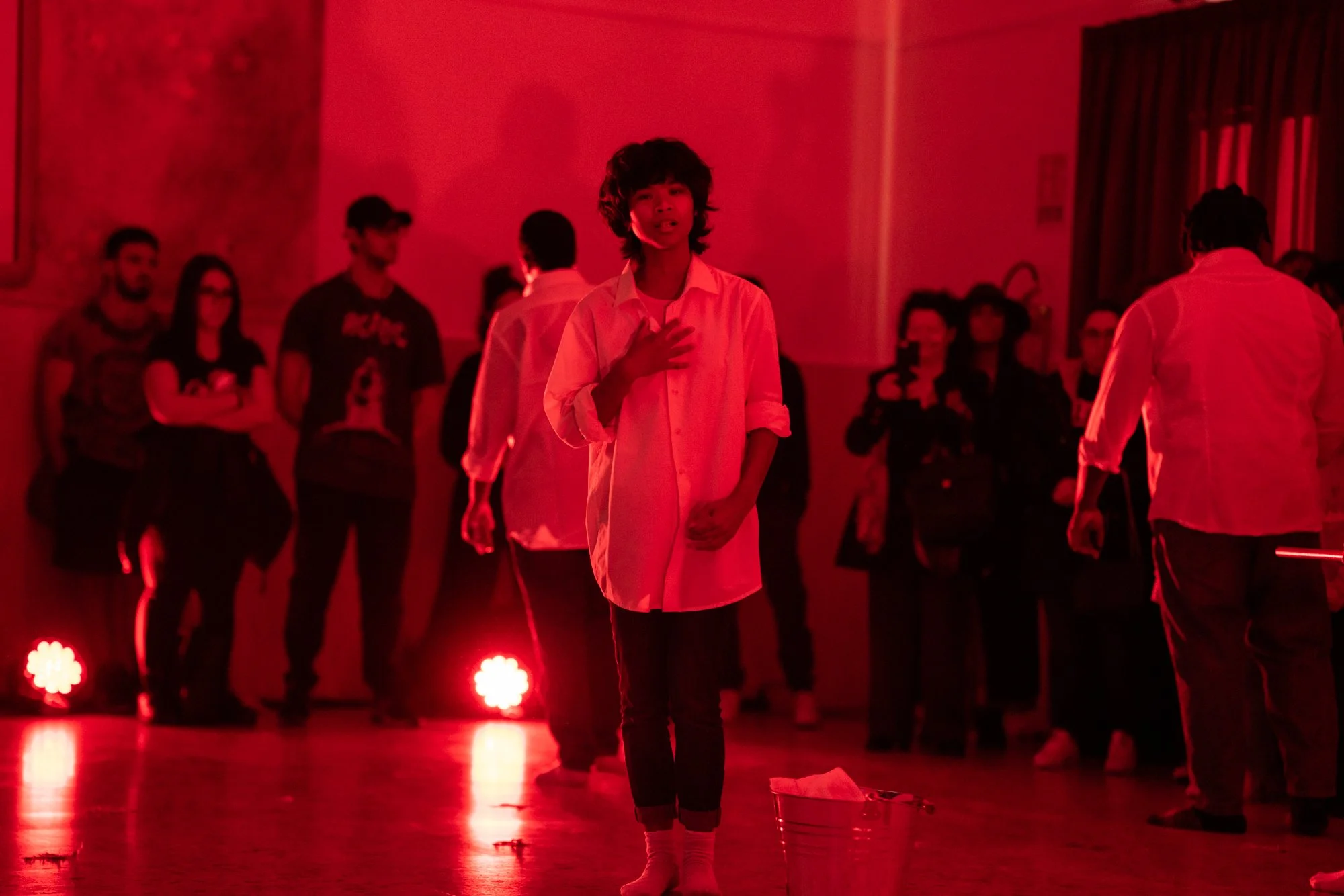
Back to the ship, a light change occurs and everything turns into red. Diane Layno, a girl of Filipines roots begins to speak:
“I am a simple €20 banknote. Nothing more, nothing less. I've been passed around a bit, until I ended up in the hands of Filippo Turetta. If only it had never happened. Since I landed in his clutches, everything changed. I've witnessed terrible things; I don't think you could ever imagine what my non- eyes have seen.”
The girl also moves through the space while unfolding her story from the perspective of a 20 Euro bill. She uses this narrative device to tell us about a femicide changing the perspective, presenting money
as nothing more and nothing less than a witness. The other bodies act as support and co-creators of the narrative. They hint at sobs, the sobs that the family of Giulia Cecchettin once hinted at, because Diane is talking about her. Giulia is the victim of a femicide that became a symbol in Italy.
Quartieri di Vita 2023
But this is not the only story we are going to hear that day about femicide. It is Martina Puoti's turn, who at this point of the event starts speaking from the perspective of the victim, a murdered woman:
“One, two, two lights on, two houses in the neighbourhood that light up, they saw me, I know they saw me, I know I'm not alone. Where are you? I am here, I see you, I see that you're there and that you're watching me. I don't feel anything, I'm embraced by the cold and observed by motionless statues, soulless and icy as I am.”
The space is transformed one more time; the other performers create a play of lights with handheld flashlights and echo what is being presented. Now Martina is not giving voice to her anymore but to him, the killer:
“You know, I went out that evening already knowing what to do, I was looking for prey to satisfy my instincts, my desire was to kill, to have possession of a corpse. (...) I wanted to continue, but I saw
lights turning on. Truth be told, the awareness that someone was watching bothered me. It was MY moment; there was only me and my victim, my toy for that night. I left, waiting to be alone to return and conclude my plan. (...) Before long, I found her. She was there, lifeless and suffering, waiting for me, waiting for my return, and I waited for nothing more than to come back to her and finish what I had left unfinished. And so I did. I took everything—her life, her body, and her soul—happy to live in a society that understood and accepted my instincts.”
But who were those witnesses? Were we all witnesses, perhaps?
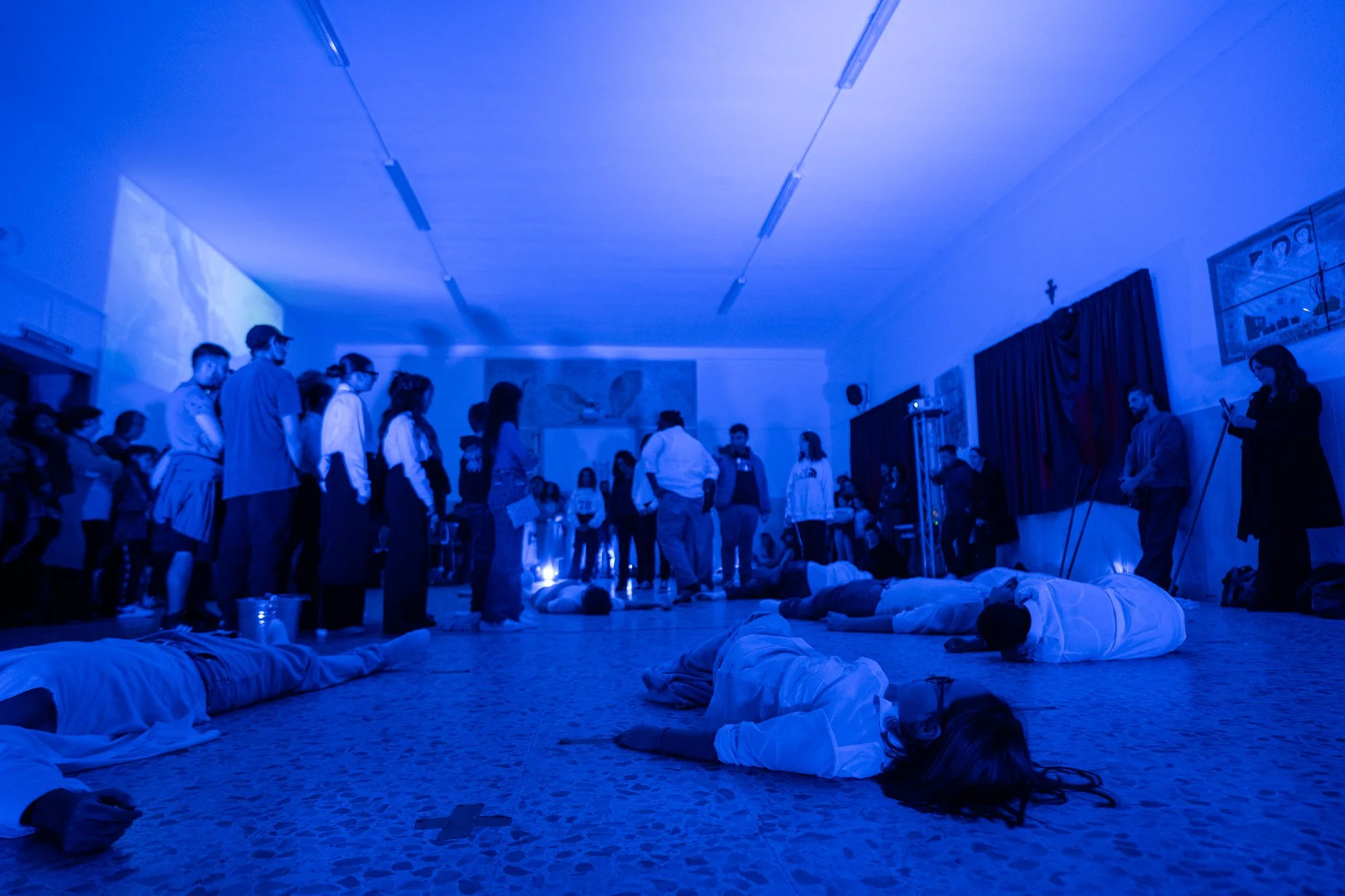
The narrative strategies used by the kids to tell the stories play with aspects such as the narration of the events from different perspectives, including that of non-human entities. Erika Fischer Lichte's studies point to the performance as an event, revealing a blurring of boundaries between the work, audience, and the performer: “(...) an event is not something that happens in the world but a change in the approach through which we perceive the world and relate to it.”
The spectacle presented a centrifugal and a centripetal movement. Two contrasting forces between dispersion and unity prevented monotony, compelling the audience to focus on numerous short intense moments, being mentally and physically involved. “The ‘body in action’ is the generative element of a process of signification, achievable through a constant play of actions and interactions between the subject and the world” (Sibilo). The bodies create the event, not the place. The place is a
condition of possibility, but the bodies in interaction are the sine qua non condition of an event. Each part of the performance was conceived to build meaning, aiming to give form to a current present, rich in meanings, shaped by the political-economic history connected to the local, regional, global, collective, and individual levels for each body.
Layers upon layers: the plague is back to stay.
Campania region is a place of immense richness and complexity, as are the social issues within it. The processes of deterritorialization and reterritorialization can be traced in the layers upon which these territories have been built, across different historical stages. What the map cuts up, the story cuts across – says Conquergood - and the word is action Therefore, recovering the deposits of individual and collective memories sheds -light on the cultural and semantic coordinates in which practices are inscribed. Each community is configured as a dynamic system, constantly redefined by the actions of its members; in these terms, the individual and the community constitute situated interactive networks, within which individuals can transform and sustain the community as they appropriate its practices, interpret them, and reinvent them. In turn, communities transform, confirm, and support individuals by offering them opportunities within a shared system of references and the appropriation and construction of knowledge and skills. “From an educational-theoretical perspective, this means that the expansion of opportunities for participation requires simultaneous engagement” (cf. Dewey, 1993). On this topic, M. Striano states that “a community learns when it acquires a new capacity to act and perform new practices. For social development to occur, practices must be continuously developed, reviewed, and transformed in response to emerging needs in the social contexts where they are applied. Social and cultural participation is not just a matter of education (in terms of imparting skills and access) but also involves recognizing cultural practices and acts of participation in which individuals engage in the context of their everyday lives and biographical identity work, regardless of whether they conform to formally institutionalized notions of ‘culture’ and ‘participation’”. An example where we can observe this phenomenon is the Cooperative La Paranza (remember I mentioned I would come back to this?) which was founded in 2006 in a neighborhood (Sanitá) where conflicts and significant resources coexist. It was born in one of the districts of Naples with the clearest evidence of great socio-cultural inequality and enormous resources existing side by side. They started their activities in 2006 with the management of the Catacombs of San Gaudioso in the Basilica of Santa Maria della Sanità, followed by the recovery, management, and opening of the Catacombs of San Gennaro to the public. The Foundation brought together all the organizations that had been working in the local area for years and was created to provide stability to what had already been achieved and to promote new projects. On their website, it's to be read: “We believe that this is
the starting point for a process of self-development, which is why we decided to put our experience at the service of the Rione Sanità: not to move from our city, but to CHANGE the city. We work together to promote a culture of giving and foster social cohesion. Together we activate deep-rooted change. We contribute to revitalizing the image of the city with enthusiasm and professionalism through the rediscovery of its artistic and cultural heritage”. Visitors to the catacombs have increased fivefold, and a social economy has developed which has given rise to a network of small cooperatives and artisans. This is a clear example of what can be achieved through participation and re-appropriation of one's own cultural richness; a re-telling of one's own story. It's a matter of revalorization, and how we revisit and re-inhabit our own territories, stories and bodies. In the case of Saint Gennaro's Catacombs, those layers upon which history accumulates, the stages of that territory are re-signified by its own inhabitants, who rewrite their history and reclaim their place. In the case of Quartieri di Vita ́s performances, the layers can be glimpsed in the rhizomatic structure, connecting and tensioning local and global issues, creating a narrative based on identity. “The diversity of the kids' backgrounds emerged completely in their texts, which showed their cultural references, their aspirations, their imaginary. For example, Victor Obayagbonna wrote both in 2022 and 2023 two visionary, prophetic, passionate texts, which echoed biblical language. It is no coincidence that his father is a Pastor. In Giacomo Riccardo's texts his passion for comics, video games and anime strongly emerged, making his texts both adventurous and apocalyptic. In Sara Labaran's texts, her apparently disenchanted sensitivity and her complex life experience peeked out. Word is life” (Costa). The artistic expression in these works merges with a political purpose, thus contributing to the construction of collective narratives and social mobilization in specific community contexts. “The relational, performing, theatrical and visual arts, by definition, mix otherness and identity, emotions and rationality, individual and community. These are the same categories that politics is based on. After all, Jacques Rancière explained perfectly how politics and aesthetics are the two sides of the same coin” (Costa). This aspect took form in the meeting between young kids - who experience the social discomfort of living in a difficult area - and their families and the local community through an international project and both local and universal themes. “Merging all this in the assembly hall of the local school (since there are NO theatres within 50 km, which also means something...) created, like it or not, a truly public, shared space for social and civic debate. It doesn't seem like a little thing to me...” (Costa). Other examples of community theatre in Naples account for the impact and scope of these projects in terms of multi- territorialization. Such is the case of Arrevuoto, a theatre and pedagogy project operating between the outskirts and the centre of Naples, or the Ciro Colonna Multifunctional Centre, an huge educational and recreational centre, a meeting and expression space where the Maestri di Strada Association operates. These spaces are essential in the construction of a territorial network that engages its inhabitants, restoring to them the experience of reconnecting with the territory, to spread a
new meaning to it. It is about recognizing the richness in the territory we inhabit, revaluing it, and multiplying it. The key and the challenge seems to lie in giving projects continuity over time. About this, Christian says: “I usually work on public art projects with a strong relational character, focusing on communities and territories. For me, working on difficult contexts and issues is always aimed at generating long-term discussions and interventions. That’s why, with Antonio Nardelli and the kids, we are working on new phases of the Quartieri di Vita project: a book, a documentary and a film. The first thing I said to the kids during our first meeting in 2022 was that I wasn't interested at all in coming to Grazzanise. I was interested in returning to Grazzanise. It is the duration of the work that defines intentions, expectations and, ultimately, also the results of a project”.
Hopefully the plague of theatre will invade us, infect us, and stay with us forever... Looking forward to Quartieri di Vita edition 2024.
